Welcome

Welcome to Soundings! The blogsite of Caitlin Matthews.
Exploring Myth, Divination and the Western Mysteries.


Saturday, 28 April 2012

JUST HOW LONG HAVE
WOMEN BEEN FROM VENUS AND MEN FROM MARS? 
 -  ON THE ORIGINS OF THE PETIT LENORMAND CARDS
    by Caitlín Matthews

The mystery of how men and women relate to each other is central to the work of the diviner: why does he treat me this way?  when will she notice me? how can we get back together? are common questions that clients bring to the cartomant or tarotmancer, who often find him or herself acting as an intermediary or interpreter of romantic relationships. However tempted, diviners must keep their neutrality while Eros aims his arrows indiscriminately.

The publication of John Gray’s popular relationship psychology book, Men are from Mars, Women are from Venus  in 1993 seemed to throw an original and quirky light upon the differences between men and women. But, in actuality, the connection between the feminine with Venus and the masculine with Mars has been established in cartomancy since the era of Etteilla, an 18th century French cartomant and tarot creator, and also of the unknown person who created the Petit Lenormand system – who may not have been Mademoiselle Marie-Anne Lenormand.  What follows is the mystery of the piquet deck, which I’ve chosen to pursue by investigating the footprint of Venus and Mars in the cards.


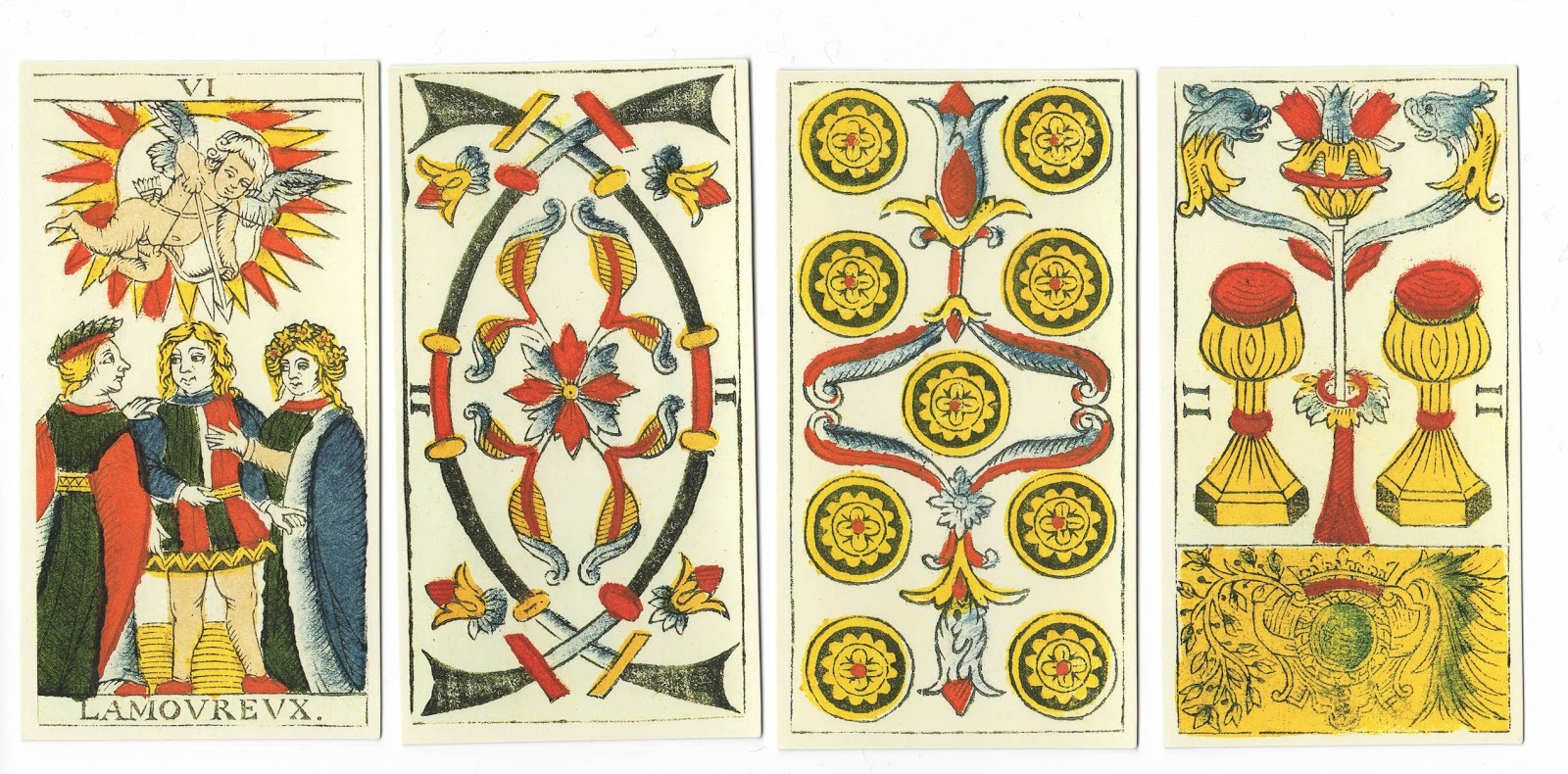
                                   Above: Petit Etteilla cards. Below: Mertz Lenormand

Etteilla was the professional name of Jean Baptiste Alliette Jeune (1738-1791), who lived at 48 rue de l’Oseille, Paris (now, rue de Poitou in the 3rd Arrondissement.)  Etteilla, whose calling card proclaimed him as ‘professeur d’alegèbre’, no doubt a cover for his esoteric activities that were proscribed under French law, was greatly inspired by the arcane writings of Court de Gebelin.  In 1770 Etteilla published a book called ‘Etteilla, ou maniere de se récréer avec un jeu du cartes par M***’ (Etteilla, or A way to entertain yourself with a pack of cards by Mr ****).  This system of divination was based upon the common 32 card or piquet deck that was used in France and Italy at the time, but with Etteilla’s unique spin.  A piquet deck is one in which the 2-6 cards have been removed, as was used in the playing card game, piquet.  

The playing card game of piquet, in which Ace is high, was mentioned by Rabelais in 1535, and was well established by the mid 17th century.  The aim of the game is to ‘get over the Rubicon’ by gaining 100 points in a partie or round. When players receive a hand containing no court cards, they may call ‘Carte Blanche’ and receive 10 points.  With only 32 cards, it makes a fast game in which concentration and counting are requied.  Etteilla obviously knew it well.

In his fortune-telling piquet card system, Etteilla assigned a 33rd card to the questioner, making a Significator card which Etteilla called ‘the Carte Blanche,’ obviously drawing on the game of piquet. Petit Etteilla cards also had upright and reversed meanings, at this time when double-headed cards had not yet been invented. He revealed a number of ways in which the cards could be laid in subsequent editions of a book called Etteilla, ou la seule manière de tirer les cartes (Etteilla, or The Only Way to Read the Cards) in 1773.

                  
The Spread called ‘Coup de Etteilla’ from La Seule Manière de Tirer Les Cartes of 1773, using an ordinary 32 piquet playing card deck with the Carte Blanche shown at position 2 in the top right hand corner.

In his Petit Etteilla, Etteilla’s ascribes Ace of Spades to Venus, with the meaning of ‘a trifle,’ while to Ace of Hearts he gives the meaning of ‘the Present.’  When the card appears next to his Significator, which he modestly entitled the ‘Etteilla’ card, Ace of Spades signifies neglect, while Ace of Hearts means suspicion. The only other card assigned to a planet in the Petit Etteilla is the reversed 9 Spades: always an unlucky card in cartomancy, 9 Spades is assigned the meaning of ‘Illness’ in this system and is under the aegis of the unfortunate planet, Saturn. 

Why did Etteilla ascribe these cards to Venus and Mars?  Spades is not the first choice if you are looking for a card of Venus, unless you are exploring her Erisian tendencies.  (Eris was the Goddess of Discord.)  Mars is similarly not commonly associated with Hearts – it’s almost as if they have swopped suits!  Furthermore, Etteilla had already assigned the colouring and characteristics of people to the court cards, with the Heart suit representing blonde individuals, and the Clubs suit representing dark haired people, with Diamonds and Spades furnishing the professions and ages of different kinds of people.

If we peer back into the mists of time, we discover other more obvious depictions of Venus and Mars in cartomancy and tarot.  In 15th century French cartomancy, we find the Queen of Hearts is called Venus in the 1493 pack designed by Jehan Personne, master cardmaker from Lyons.   (Editions J-C. Dussiere.)  This pack assigns Queen of Diamonds to Helen of Troy, Queen of Clubs to Melusine and Queen of Spades to Jeanne la Pucelle.  Venus as Queen of Hearts seems entirely fitting, while the martial virgin, Joan of Arc, takes on the role of Queen of Spades.

Dame du Coeurs from Jehan Personne's Playing Cards of 1493

 We can also see from the Mantegna Tarot of c.1465 that Mars and Venus resemble the major arcana tarot cards of VI Lovers and VII Chariot, with Venus rising from the sea, the element of Hearts or Cups, flanked by Cupid and the three Graces as her handmaids, and Mars sits on a triumphal car like a returning war commander with his sword – the emblem of Spades. These are fitting emblems of the divinities of Love and War, belonging to the sequence of cards depicting the planetary gods.

Venus and Mars from the Mantegna Tarot c.1465

The association of Venus and Mars with the Ace of Spades and Ace of Hearts reappears only in the 36 card Petit Lenormand decks of the mid 19th century, as we can see from the early Lenormand Mertz deck shown at the top of this blog, dating from about 1848-50s.  The Woman and Man cards in the Petit Lenormand system represent the Significator: female and male clients have a dedicated card whose appearance in a tableau spread, where all the cards are used.  Wherever the client’s cards fall in the spread, those cards nearest to it are significant and have strongest effect: those further from the Significator are weaker and have less effect. A female client’s Woman card is examined, as well as the position of the Man card, since it may show how she and her significant other are associated. 

This system of cards is named for Mademoiselle Marie-Anne Adélaïde Lenormand (1772-1843) and is known generically as the Petit Lenormand; it has 36 cards, which is a piquet deck of 32 with the addition of the four sixes.  Lenormand rose from humble origins in Alençon to become ‘the sibyl of the salons’ in Paris.  A gifted diviner, she used many different methods to predict or envision her clients’ fortunes.  Besides coffee grounds, and the inspection of heads, faces and palms, she undoubtedly used the Petit Etteilla cards, German-suited playing cards (with their acorns, leaves, bells and hearts) and cards of her own devising that had constellations upon them.  (These were not the cards now known as Grand Jeu de Mlle. Lenormand or Astro-Mythological Cards which were produced by Grimaud two years after her death in 1845.) 

Lenormand wrote many books and, with her following, would surely not have been diverted from producing cards, had she so wished, just as Etteilla had done before her.  The production of such cards would not have proved impossible, given her immense income from celebrity clientèle.  It has been proved that Etteilla’s proactive publishing has its roots in his own experience as a print-seller: this would have brought him into close association with printers. With an eye to the main chance, he saw ways of benefiting from this association by creating books and card systems of his own. He invented not only the Petit Etteilla cards but two tarots: but is the piquet deck that interests us here.

In actual fact, the Petit Lenormand deck images derive from a German game called Das Spiel der Hoffnung, published in 1800 by G. P. J. Bieling-Dietz of Nuremberg. This was a board game in which 36 cards were laid in a square while competitors raced to be the winner; it was played by two dice to determine how one advanced around the board.  Like Snakes and Ladders, you might advance or retreat if you landed on particular cards.  The cards have the same numeration and images as the Petit Lenormand cards, conclusively proving that this was the origin of the images and their ordering.  The accompanying leaflet to the game also suggested a simple question and answer whereby 32 cards laid in eight rows of four might answer questions. (Compare the Coup de Etteilla spread above, which is an early form of tableau reading.)

Many people are astonished that this seemingly French system has a partial German origin. This game and the French method of fortune-telling with the piquet cards was evidently married together to create the Petit Lenormand style cards, in a Mars and Venus style marriage.   A close comparison  of the divinatory cards that appeared over the period from the late 18th century to the mid 19th century and beyond show a distinct trail back to this marriage of piquet and a German game.  Yet, despite Lenormand’s name being associated with this divination method, she did not necessarily invent it. The game called the Le Grand Jeu, published by Grimaud in 1845, appeared two years after her death and was merely a way of cashing in upon the Lenormand name.  Le Grand Jeu is a pack of 52 cards with classical images as their main picture, and so it is not a Petit Lenormand pack.

If we look at traditional Cartomancy, Ace of Hearts is associated with the establishment of house and home, settling down with a partner and with romance.  On the contrary, the Ace of Spades is most commonly considered to be ‘the death card,’ or which, at its very least, signals a call to change or an unwelcome development.  Yet, Mademoiselle Lenormand, after whom the Petit Lenormand cards are named, saw herself as ‘the Ace of Spades,’ a strong, healthy but hardly beautiful young woman who achieved celebrity status as a diviner to the Empress Joséphine.  Lenormand survived the Terror, to become  ‘the sibyl of the salons’ during the Napoleonic era and the subsequent Bourbon restoration.  Her survival of several terms of imprisonment for illegal divination is testimony to her toughness: she remained a life-long spinster, cultivating a sibylline appearance, wearing a black dress and a black wig which accentuated her dark eyes. 

Was it Lenormand who determined that the Ace of Spades, following Etteilla’s ascription of Venus to this card, should stand for all women, and Mars for all men?  Possibly – we cannot conclusively tell.  Whoever prepared and invented the Petit Lenormand cards followed Etteilla’s strange cross-ascribed suits and found them suitable.  Might the heart of a single woman looking for a man to complete her happiness  assign the Ace of Hearts to the male Significator? I leave it to your judgement.  In doing so, the Petit Lenormand inventor certainly pre-empted Jung’s concept of anima and animus by a good century, in the cross-ascriptions of Mars to the Ace of Hearts and Venus to the Ace of Spades!  

The Petit Lenormand style of oracles spread extensively and speedily through Europe, but most particularly into Germany where it has had its fullest expression.  This was partially been due to the draconian laws against divination that obtained during Lenormand’s own lifetime and into the present age.   Parlour oracles which married images to cartomancy, featuring playing cards upon them, resonate still with the Petit Lenormand system, especially the Sibylla Cards and Gypsy Oracle cards, which have a 36 card layout (though more modern or reproduction Sibyllas lack the cards these days.)   German Kipper Cards, which do not feature playing cards, also retain a 36 card format.  All of these cards stem from the piquet deck.

Etteilla and Lenormand remain the god-parents of the piquet deck fortune-telling cards that we know as the Petit Lenormand system. They are the Mars and Venus of piquet: a self-promoting dandy of an Ace of Hearts, and a plump and unlovely diviner who thought of herself as the Ace of Spades.  Their marriage of ideas has brought us a system of divination that many are rediscovering with wonder today, as conventional tarot exposition begins to pall, and the call of early cartomancy is reawakening.  As with any meeting between love and war, Venus and Mars still engage with their own brand of romantic dissention, but it is a fruitful edge whereat we may find the essential tools of divination.
                           
                                                   ***
                              
Here is a Petit Lenormand spread for those who still wonder what Venus and Mars hold for them in relationship terms.  You will need a Petit Lenormand pack or else an ordinary pack of playing cards, if you are a cartomancer.  Place your Woman or Venus (Ace Spades) card to the left of position 5 and your Man or Mars (Ace Hearts) card to the right of position 6 and read away!

                           1.                                             3.
      WOMAN       5.                    7.                      6.            MAN
                           2.                                             4.

1. What's in her mind?
2. What's in her heart?
3. What’s in his mind?
4. What’s in his heart?
5. What she gives/withholds
6. What he gives/withholds
7. Where they meet.

Read cards 1 & 2, and 3 & 4, 5 & 6 as a pair. Then read 1,5,2 and 3,6,4  as triplets which show the disposition of the individuals in the reading.  Finally read 5,6,7 as a triplet to determine the nature of  the relationship at this time.

This article is extracted from Caitlín’s Enchanted Lenormand Oracle, with 36 cards illustrated by Virginia Lee, appearing in 2013. The book accompanying the cards gives background to the Petit Lenormand origins, a full list of meanings, guidance on how to read Lenormand cards (which are read very differently to the way in which we read tarot cards), as well as  practices and spreads that will help beginners deepen their experience.   
See http://www.hallowquest.org.uk/ for more details.

Friday, 24 February 2012

THE BRIGHT KNOWLEDGE: THE WORLD OF THE CELTIC SEERS

Celtic Visions

‘There was a tall man sitting next me, and he dressed in grey, and after the Mass I asked him where he came from. "From Tir-na-nOg," says he. "And where is that?" I asked him. "It's not far from you," he said; "it's near the place where you live."- Mrs Sheridan, in Lady Augusta Gregory’s Visions and Beliefs in the West of Ireland,


What we see and what we imagine has one connected life, but it is only when we enter into dialogue with the otherworld that we understand that.  It is 'not far from us.' Seers and visionaries perceive that the spiritual and emotional meaning of life is not found just on one shore of reality but is brought to us by the tides originating on the further shore, by way of dream and impressions that we today tend to neglect as irrational promptings of no account.
          What if we were to live as if that dialogue were the truest thing we ever did? As a hunter examines the grass for the track of the deer, as a lover looks for response in the face of the beloved, so we too need to search the hinterland of that further shore with imagination and intelligence.
          For the people of the ancient Celtic world, seership opened windows into the otherworld,  awakening the essence of true vision and wisdom which was known by the poets as the gléfiosa or ‘the bright knowledge.’
          Seership connects the two sides of reality: both the physical world which is perceptible by our everyday senses, as well as the invisible, unmanifest world which we perceive with our inner senses.  When seers go seeking, they expand their consciousness to perceive the wider reality of the whole, able to sense from the movement or location of animals the coming of a dangerous event or when a sickness augurs death. 
          The primordial condition of the human soul is based upon metaphors of perception: the symbologies of this primal language of the soul are received by the inner senses and conveyed primarily through the images and metaphors of storytelling, song and poetry.  When viewing a landscape, the seer sees not just the hills or rivers but a living world in which the sound of the waters, the wind through the trees and the movements of animals are meaningful.  Each place has its own memories where certain teachings or stories may be remembered.  A land-feature has power to reconnect the physical and unseen sides of reality, becoming a threshold where past, present and future fuse into a single focus for knowing and understanding. 
          Some people are born with the ‘second sight’ which, in Gaelic is called an da shealleadh, literally meaning ‘the two seeings.’ Possessors of the second sight perceive not only the physical semblance of a person or event but also its spiritual aspect as well.  In an age which welcomes all kinds of signs and wonders, it should be remembered that the second sight was and still is not a welcome gift, for it comes unbidden and can seldom be ignored or removed,  only ‘tuned down.’
          Seers were pragmatically sought out to find lost people or animals that had strayed, to discover news of far-travelling relatives or those who went into battle in an age with no instant means of communication.  The interpretive skills of the seer might be welcome in times of need or very unwelcome indeed when the seer’s seeing brought inconvenient truths to the surface.
          Methods of Celtic seership and vision have been my study for many years, both from written sources as well as from oral transmission and personal practice.  With many students worldwide, I’ve explored how these methods can work today.  Seership is an inborn gift but vision is a skill that can be re-awoken within us by patient observation and faithful practice, by stillness, and the absence of stimulus or interruption. By slowing down, carrying a question patiently within our hearts, we can consider the evidences of our heightened senses and the verifications of our dreams.  This book offers a short study of Seership and has its own pointers to the development of vision.

CELTIC VISIONS: Seership, Omens and Dreams of the Otherworld. Watkins, 2012.

Saturday, 17 December 2011

Epona's Day

EPONA’S DAY – the Gifts of Midwinter
By Caitlín Matthews

This morning I rise early with anticipation and excitement. Snow was forecast last night.  Drawing back the curtains, I find a thin layer of fine whiteness making bright the early morning darkness. No bird breaks the stillness with song or movement. It is a perfect hour for the dawning of Epona’s Day.
I go to my shrine and light up the altar of Epona/Rhiannon and consider all that this day means.

18th December is the day on which the pan-Celtic Horse Goddess, Epona, was celebrated – the only feast in the later Roman calendar dedicated to a Celtic divinity.  It was the day when all the cloven-footed beasts – horses, donkeys, cattle, oxen – were rested and not made to work.  She is remembered every year by me for this day is one on which I never work. That tender, fiery-passionate saint, Francis, often referred to his physical body as ‘Brother Ass,’ and, indeed, sometimes the old ass refuses to shift another inch without a rest! At other busy points of the year, I often declare it to be ‘a refreshment day,’ in Epona’s honour when I feel that the pressure of work is creating stress and disconnection from the important roots of my creative fertility.  She will bear me far but not to the world’s end unless I spend time listening to her wisdom.

What is the reason for Epona’s incorporation into the Roman calendar?  And why is it remembered so near the Solstice? Well, the early Romans celebrated midwinter with rites to Ops and Consus, the Sabine deities of the underworldly earth whom they saw as resonant with Rhea and Saturn. Ops
was the goddess of abundance and is related to the word opus or ‘work.’ Consus had a temple upon the Aventine but, as god of seeds and grain, he had an altar in his underground granary under the Circus Maximus – the entrance to this was ceremonially uncovered on his feast days.  Consus was associated with horses and, by extension, by those beasts that ploughed the fields. 

The midwinter rites of Ops and Consus on 17th December began the festival of Saturnalia – the intercalary days when business ceased, when people could publicly gamble and wear informal clothing, and when slaves’ duties were relaxed and households elected a mock king to preside over the festivities.  Prior to Christmas, Saturnalia saw much merriment, feasting and giving of gifts.  Horses and mules were rested from ordinary work duties and garlanded, while the pontifices (priests) used the Circus Maximus arena to race mules.  This custom of racing mules in honour of Consus reveals his close connection with Saturnine duty of restoring the flagging midwinter sun to its point of renewal over the solstice.  The Gaulish goddess Epona became incorporated into Roman religion  because of the Roman army whose cavalry was made up of levies of men from Gaul, the Low Countries and Germany: the influence of riders and grooms who depended upon their horses brought Epona into association with the midwinter rituals.

18th December is also when we begin the winding down to Solstice – literally ‘the sun’s stand still.’  Although the busy days of Christmas preparation consume our hours: getting the tree up and decorated, buying and packing the last presents, stocking the larder with rich foods to share with friends and family,  Epona still has her place, though we do not remember her.

There is little myth or story that has come down to us about Epona who was worshipped among the Gauls and in Britain and Ireland under a variety of names, including Rhiannon and Macha. One fragmentary source tells us: 'A certain Phoulonios Stellos, who hated women, had intercourse with a mare. In time, she brought forth a beautiful maiden whom she named Epona, a goddess of horses.'  This ability of Epona to be both a woman and yet have the ability to change into a mare remains strongest in European folk story where the enchanted mare is the source of great wisdom and redemption, as we can see in the First Branch of the Mabinogion where Rhiannon is falsely accused of eating her own child and is forced to stop all comers to the gate, tell the false tale about her deeds to visitors and bear them into the hall on her back. Or in the Irish stories of The Haggery Nag or Baranoir where wise mares become women.

Classical sources reveal something about the rites of Epona. The Roman satirist  Juvenal writes about the horse-crazy young noble, Lateranus, who hangs out with low-life grooms in order to tend to his horses: ‘he swears at Jove's high altar by Epona, whose picture's daubed/ on the doors of his reeking stables.’

Epona’s image appeared in stables from Gaul to Thessaly: ostlers offered her roses. The Roman legions in Germany and the Low Countries dedicated many inscriptions  to her, where she is shown with a foal following her progress, or with a foal or pair of foals eating from the manger of her lap or as a woman seated upon a horse. The custom of Epona's rose garland and her association with asses and horses may also give us a new insight into the predicament of Lucius Apuleius who, in The Golden Ass, is turned into an ass by mistake. He is destined to remain in this unfortunate shape until he can consume roses. While in the stable he notices a little shrine of the Mare-Headed Mother, the Goddess Epona, standing in a niche of the post that supported the main beam of the stable. It was wreathed with freshly garlanded roses but, unfortunately, before he is able to eat them, thieves break in and he begins a long series of adventures in his asinine shape. It is not until he encounters a procession in honour of the Egyptian goddess, Isis, at which he eats a garland of roses, that he becomes a man once more.  His shapeshifting can only be ended by the Goddess.

Many depictions of Epona show her as a woman riding a horse, always moving left to right.  In Christian iconography, the Flight into Egypt – the occasion when the Holy Family had to flee from Herod’s child-massacre - shows Mary upon a donkey with the child Jesus in her arms.  She does not ride astride but is seated on the right side (not the more usual left) of the animal.  The chalk hill-figure of the White Horse of Uffington is also facing the same direction, moving sunwise, pulling the sun from solstice to equinox again.

Epona ushers us into the deep gifts of midwinter and invites us to rest, to cease from our shapeshifting and realize that we are not super-beings but souls whose bodies need the grace of refreshment and the garlanding of festival.  In midwinter’s rest lies the deep wisdom, the seeds of our renewal whereby the new year can be fruitful.  If I run headlong from one task to the other without that grace, I make a bodge and become just a work horse. 

I invite you, enter now into the stillness of solstice, uncover the altar of your deep gifts and give thanks for Epona’s wisdom.

To read more about Epona/Rhiannon, see chapter 2 of my Mabon and Guardians of Celtic Britain (Inner Traditions), which is volume one of my study and key to the Mabinogion  - the major sourcebook for early British myth. Signed copies available from www.hallowquest.org.uk

Wednesday, 8 June 2011

SHOWING FORTH THE STORY: Belief, Tradition, Prophecy and the Hierophant

The Hierophant is one who shows forth what is holy. He is primarily associated with the flow and transmission of tradition, a concept that troubles a few in our free-thinking times. Let’s remember that ‘tradition’ derives from the latin traditio or ‘I hand over.’ Tradition is not fixed, but is an ever-flowing wisdom in every generation.
          The ancient tarots make this card a Pope, while the more recent ones return to an older tradition of the hierophants of the Greek Mysteries.  Both Pope and Hierophant drawing upon earlier traditions and represent important concepts. Drawing upon pre-Christian Roman religion, the Pope is called the pontiff or bridge who, in his own person, bridges this world and the other.  The ancient Mystery Religions were largely about the revelation of myth through dramatic representation or sacred ritual.  This is still an important part of our divinatory profession whereby the tarot-reader bridges the everyday and the deep worlds for the client, through the medium of the cards’ story.
          The stories that we tell and the ones we believe in, guide our souls.  This is why, when I created the Arthurian Tarot, the Hierophant card depicts the Welsh poet, Taliesin, relating his own story of intitiation and transformation to the two children hearing him.  Over the back of his bardic chair and falling through his fingers is the golden chain of the story that helps hearers make and keep their own links with the holy and mythic.

Taliesin from the Arthurian Tarot by Caitlin & John Matthews, art by Miranda Gray

          For me, this concept of sacred connection has been central to my life.  I would argue that, rather than representing a fixed and inflexible dogma (which I would associate more with its reversed meaning), the Hierophant stands for those traditional life-guiding myths and stories that uphold our life.  When the Hierophant speaks ex cathedra, in him are met both the authority of experience and the authenticity of living from that deep knowing. 
          We live in times where the river of tradition has flowed out from religion into spirituality.  Tradition finds its own level in every generation, flowing wherever we can catch its precious drops.  We learn from its stories and myths and we make them bridges that enable us to live effectively: our belief in them captures our imagination, so that we can enact all the gifts we’ve been given in this life.
          But there are some who cannot feel safe unless their religion or belief becomes a perimeter fence that separates them from the world: the fundamentalist mentality is fearful, clinging to known constructs and fending off any changes.  This is where tradition becomes rigid concrete rather than a river that flows and finds new channels.  Traditional and holy precepts can become mandatory and imprisoning under such a régime.  The original sacred sayings freeze-dry into dogmas.  This is where the Hierophant becomes dictator and spiritual tyrant.
          There are also those who have little or no purchase on any tradition. Rather than finding the tree of tradition, they cling to the wind-blown twigs and leaves of the  –isms, -ologies and self-help theories, the very tattered remnants of tradition that bear little relationship to the tree on which they once grew.  For them, every little movement is a sacred omen and anyone who sounds authoritative is someone to follow, as we saw when the US preacher Harold Camping’s belief that the world would end on 21 May  2011 (now ‘postponed’ till 21 October 2011!),  caused believers to imagine they would ‘enter the rapture.’ Many believed implicitly in Camping, selling their goods or sending their children’s education money to his campaign funds.  False prophets and those voices that whisper ignorant stories into our ears are also part of the reversed Hierophant who undercut our primal, sacred belonging and replace it with fear.
          In our own field of operations, we should be aware of how much 2012 mania is severely affecting people, making them panicky as Mayan Prophecies and the progress of a long star-cycle comes to its end and starting point again.  When Christian millennial prophecies join up with esoteric prophecy and the astrological observations of an ancient people, we have an explosive mix.  This came home to us recently when my husband, John Matthews, who has just sold The Lost Tarot of Nostradamus, overheard one of his publishers remark:  ‘Didn’t Nostradamus prophecy the end of the world in 2012? We should aim to get it published as early as we can!!!!’  This kind of consciousness, based on fear-mongering is not what we want to foster, we assure you!  John immediately pointed out that his new tarot wasn’t about doomsday scenarios but how to live wisely and with insight all the years of our life.
          Such literal-mindedness is a real fact of our times, as many lose their links with the holy bridge that connects us with the other side of reality.  We really need the wise voice of the upright Hierophant, reminding us of the life-guiding myths and telling us once more the saving stories that uphold and affirm our life-purpose. The myths and stories that guide our souls enable us to have flexible imaginations,  helping us find our way out of the unhappy corners that the loss of resourceful stories pastes us into, and showing us the wider wholeness in which we live.
            Omens and portents are the traditional signposts of the true prophet and way-shower to come and point the way back to the ancestral restorative of thankfulness and offering, as Merlin reminds in his prayer: ‘Highest Creator, I should be obedient to thee, and show forth Thy most worthy praise from a worthy heart, always joyfully making offerings.’ (Vita Merlini) When human anxiety and trouble overwhelm us, the truth is hard to seek.  But instead of ploughing on till the last day of doom in fulfilment of horrific, world-ending prophecies, we can look once more to the treasury of our destiny.  The gifts that have been given to us look not only forward to the future but also back to their roots in the past.  They are a precious wisdom that frames and shapes our story.
          I am out to allay the kind of fears that arise from believing in stories and omens that warp our lives, and to reconfirm the resources we have.  It is part of the tarot reader’s hierophantic task to tell the story of the cards in such a way that it will be helpful to the client, so I’ve devised the Hierophant’s Bridge Spread that may help guide the fearful through this year, next year and beyond.  This includes three factors that shape our lives: Fate, Destiny and Free Will.
          Fate is that which we cannot alter – e.g. our place of birth or basic physiology.  Destiny is that which lies potentially within each of us: e.g. the gift of art that can develop, with practice, until we attain artistic expertise, or that can simply remain a pleasant hobby.  Free Will is about the choices we make for ourselves, the game we play with what we are given (both our Fate and the potentialities of our Destiny) and where we centre ourselves.  

HIEROPHANT’S BRIDGE SPREAD

Shuffle and cut, laying the cards as following.  Whichever card lands on position  5 is the Significator or ‘yourself as hierophant,’ who represents you through this three year reading and who is the fusion of your authentic and authoritative self. This is what the horozontal lines mean:

          Wisdom of the Years Behind Me:        top 3 cards -  Before 2011
          How I Wisely Traverse 2012:        middle 3 cards  - 2012
          Wisdom of the Years Ahead of Me:  bottom 3 cards - 2013 onwards
      
The Hand I’m Dealt/   The Game I Play            The Hand I Create
Me & My Fate          /Me and my free will       /Me & my destiny
           1                               2                        3             2011 & before
           4                               5                        6             2012
           7                               8                         9            2013 onwards

I hope this spread enables us all to see our lives as an ungoing totality. Fate, Free Will and Destiny are the hierophantic triple crown of all human beings: let’s wear them with pride and confidence and not be afraid of beliefs and prophecies that remove us from our own sacred connections.

The Arthurian Tarot will be reprinted in August 2011 and will be available from http://www.hallowquest.org.uk/. The Lost Tarot of Nostradamus by John Matthews & Wil Kinghan is published in 2012.

Wednesday, 22 December 2010

Midwinter Stillpoint


I sit and write at fall of dark.  Outside, all is white from the freshly fallen snow upon the earlier snow that lies ghostly over every bush, tree and building.  The stillpoint that is the fulcrum of the year, the stillness from which our energy arises is here with us and I honour it with remembrance

From here on we enter into the magical intercalary days that our year-making ancestors had left over from their division of the year into months and days.  In these days out of time, the magic and myth of the first creators is remembered.

Across megalithic Europe and here in Britain and Ireland, the chambered monuments with their long sun-seeking tunnels, conduct the first or the last rays of the midwinter sun into their depths to awaken the ancestral bone-ash and waft it into immortality.  At Maeshowe in Orkney and at Newgrange in Ireland, the ancestral dust is rising as I write.  Ancestralization of the dead was a two stage business in ancient past: first the initial burial or cremation with the loss and mourning and then, months later, the gathering up of the bones or cremated ash into another place of honour so that they might rise up collectively from their human state into their ancestral condition. 

In these magical days, the animal ancestors also come to visit us in the many disguisings that take place across Europe from now until the loosening of winter’s grip in February.  Animal disguising, where the guardian animals come out to walk and dance the streets, still happens here in Britain.  The hobby horses, straw bears and other spirits come to knock on our doors and remind us that the wild is our ancestor too and that our instinctive cunning, our lust to be in union with another of our kind, our ancient wisdom memory are inheritances that we share from the animals.

What tales do you tell at Midwinter?  What are the legends and stories that keep faith with your spirit?  I mean the original, deep core stories that arise from our oral memory and not the media-driven images of tv or film.  If you lost electrical power now and had to tell a story, what story would it be?

The Christmas preparations and holiday travel often displace the stillpoint at which we refresh ourselves.  So we go on through the holidays void and lacking in energy because we forgot to stop too.  Even when we are on holiday, there is little stillness and too much stimulus.

If you are missing the stillpoint of Midwinter because you are rushed, distracted and hassled, here is a way of returning to yourself, a small meditation whose results will always be helpful to you and whose results will please you.

* What is the place that gives you strength?
* What is the gift you share/inherit from ancestors?
* What is the blessing you were born to deliver?

Consider your answers and find symbols for each – easy to remember ones that are significent and original to yourself. Visualise the place symbol as being beneath your feet.  Feel the symbol of the ancestral gift as if in the core of your body.  Be aware of the blessing symbol as a crown, head-band, or guiding symbol over head.  Whenever you feel scattered, you too can return to the Midwinter stillpoint and centre your souls – yes, we have more than one soul.  (See my Psychic Shield (in USA) which is called Psychic Protection Handbook in UK for more on our different souls.)

I sit in the grey darkness now as the last light leaves.  The sky is reflective of the earth-bound snow.  It is still and silent everywhere.  I am going to turn off my computer to rest now, as I shall rest during the twelve days that mark my own still point.

From The Book of Ancestral Welcome – a book in progress, by Caitlín Matthews

Tuesday, 9 November 2010

Ancestral Roots

The source of my interest in things ancestral is probably not much different from your own.  Curiosity, fascination and a love of history were on one side. On the other was a sense that ancestors were mysterious.  My mother didn’t grow up with her birth family, having been fostered on a childless aunt when she was only 6 weeks old.  She grew up with a child’s bewildered sense of abandonment at an act whose purpose and motivation still remained unknown until her death 85 years later. I subsequently grew up knowing only my father’s large family, appreciating my paternal grandparents where everyone gathered on Saturday afternoons at their house to argue about politics and sport, never religion. But I knew that I had another heritage somewhere and was missing something vital. Throughout my teenage years I wanted to get my mother’s family for her and for me. I finally tracked down my aunts and uncles, and arranged a family reunion, being mystified when my mother and they failed to bond.  Too much acrimony, division and lack of nurture had flowed under that bridge, I realize now.
But besides that family mystery, I had a sense of ancestors as something greater than my immediate relatives.  I experienced ancestors everywhere, feeling a kinship with the rolling hills of the South Downs, with the sea, with animals and trees.  Children have no tribe and are able to make friends with beings and people of all kinds and ages: I never lost that sense.  There were also dimly sensed beings, human ancestors who seemed to be observing me.  I would catch sight of them at the edge of sleep and dream, in quiet moments. I didn’t know then what to do about them or how to be with them; I didn’t fully understand what or who they were.  They carried a great power but, because power and fear are the two sides of one coin, I was simultaneously attracted by their power and repulsed by my own fear.  Their attention seemed to grow stronger as I went through puberty, as if I were becoming important to them in some way, making me feel doubly uncomfortable and embarrassed.
Despite this, ancestors kept showing up and finally I had to really look at them.  The surprising thing was that when I did focus on them, rather than my usual glance and look away, that strength began to flow towards me, a strength that was the kind of strong love crowds demonstrate towards a winning competitor.  This was simply astonishing.  What had I done to disserve this attention?  After all, I had grown up in a family where no-one was praised or honoured, where achievement was diminished by slighting criticism, where love was not demonstrated by signs of affection but by distancing jocularity, so I was overwhelmed with gratitude.      
Looking back, I can see now that the ancestral birthright that should have come to my mother and thence to me had been somehow thwarted by her own childhood abandonment and by the family rift that resulted.  But the ancestors didn’t want me just to bask in their approval, they wanted me to work hard to discover and use the ancestral legacy for others.
Like all unskilled folk, I didn’t always get it right, mostly because I had not been raised in culture in which the ancestors were a normal part of daily life.  A pump that has been long disused is bound to have some rust in it before the water flows clear. My early attempts to teach ancestral traditions were hampered by my own lack of preparedness. There were many things still impeding my full understanding of the ancestors, including the problems of tribalism and partiality which keep human beings separate from each other, locked in a rivalry and competitiveness that .  I had yet to find and understand the language and strategies by which 20th century people could be led to their ancestors without fear.  I hadn’t realized just how high a wall separated Western culture and values from ancestral values, and so I stumbled about a bit.  I hope that I didn’t harm or disable anyone’s attempts to draw near to their ancestors. If so, then may this book make good my errors.
          Along the way I met many people who helped shape my understanding both those of indigenous cultures whose humility and ease around the ancestors was a lesson in itself, and those teachers whose examples were models of ancestral tolerance and humility.  We can learn from anyone and anything, and I was really paying attention to the signs wherever I found them. I have not arrived at a perfect understanding of the ancestors, but then, they are always free to remind and teach me more when I need a new lesson.
          Now I know that I can pray to the ancestors to help and support me and that I can show my gratitude to them in a number of ways: with my songs, with offerings, with thankfulness, including them and all who are yet to come in a thousand different acts of grace.  One of the most powerful ways of learning from the ancestors for me has been the vigil: getting up in the middle of the night and just sitting with them. That has taught me more than anything else and I recommend it as the quick route to understanding.  The privilege of the ancestral vigil, especially when you are perplexed and needing wisdom, is overwhelmingly humbling.
          All prayer for the ancestors is as a waymark and blessing, not only to them but to those who are still lost upon the road, seeking their ancestral home.  The ancient ancestral hearth and our own hearth are the same place. When we welcome the ancestors home, we ourselves cease to feel abandoned and so we come home too.

Caitlín Matthews

Caitlín’s new book Celtic Wisdom Oracle: Oracle Cards for Ancestral Wisdom and Guidance (Watkins) comes out in Spring 2011: it opens resourceful ways to work with ancestry, whether you are of Celtic derivation or not. See http://www.hallowquest.org.uk/